SCIENTIFIC CHEMICALS
Introduction to the Beilstein System
Throughout the history of abstracting scientific literature in chemistry, the name Beilstein has had a unique position of quality and value to the chemist. As a young graduate student in organic chemistry I first came across Beilstein as part of my synthesis work on a bicyclic nitrogen ring system. In 1963 it took me a considerable amount of time to search for this class of compounds and translate the appropriate sections of the Beilstein Handbook into English; now those activities take a few seconds, because the database is computerized and the information is essentially all in English. The transformation of this sleeping giant into a modern information resource is amazing and of great value to the ongoing progress of most of academic and industrial chemistry.
Table 1.1 is a brief chronology of Beilstein - the man, the Handbook, and the database. It is easy to see that the period between the first ACS book and this book was a time of major development and change at Beilstein.
Table 1.1 - Beilstein Chronology
1838: Friedrich Konrad Beilstein was born in St. Petersburg, Russia
1865: Beilstein became Professor of Organic Chemistry, St. Petersburg
1866: Beilstein became the Chair of Chemistry at the Imperial Technical Institute in St. Petersburg
1881: First Edition of the Beilstein Handbook (2 volumes, 1500 compounds, 2200 pages)
1885: Second Edition (3 volumes, 4080 pages)
1906: Third Edition (8 volumes, 11,000 pages)
1906: Death of Friedrich Konrad Beilstein
1918: Fourth Edition (German Chemical Society, Berlin)
1984: Fifth Edition in English (480 volumes, 400,000 pages)
1988: Beilstein Online on STN
1989: Beilstein Online on DIALOG
1990: ACS Symposium Series book - The Beilstein Database
1995: CrossFire - Beilstein file in-house with ca. 6,000,000 organic compounds with properties data
1996: CrossFire Gmelin - Gmelin file in-house available with ca. 1,000,000 inorganic and organometallic compounds with properties data
1997: ACS Book - The Beilstein Database and Search System
Even though the Beilstein Handbook of Organic Chemistry covers Aonly@ organic chemistry, it has been a critical resource for most of the 20th century. As we approach the 21st century the management and leadership of Beilstein Information Systems GmbH has further developed this valuable resource into a number of practical, every-day, tools for the chemist. The purpose of this book, the successor to the ACS Symposium Series book entitled "The Beilstein Online Database - Implementation, Content, and Retrieval", is to demonstrate how the Beilstein database and associated software products have been evolving over the last 7 years since the first book was published.
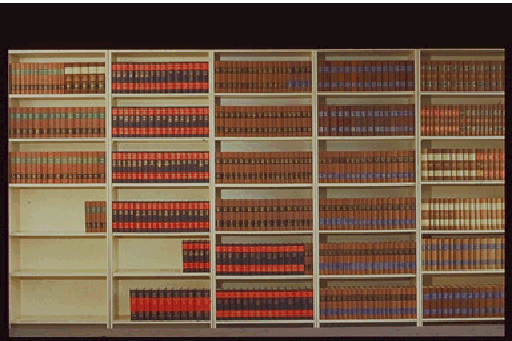
With all the changes, remodeling, and reorganization of Beilstein in the past few years into two separate organizations, the Beilstein Institute and Beilstein Information Systems (explained in further detail later in this chapter) it is probably best to first answer the question - "What is Beilstein, now?" Perhaps the best way to begin to answer this question is to show what Beilstein was in the past. Beilstein is an enormous set of reference books (Figure 1.2) that, although very well organized, occupied a great deal of space. It was relatively difficult to quickly locate information spread throughout the five different series composing the handbook.
Throughout the history of abstracting scientific literature in chemistry, the name Beilstein has had a unique position of quality and value to the chemist. As a young graduate student in organic chemistry I first came across Beilstein as part of my synthesis work on a bicyclic nitrogen ring system. In 1963 it took me a considerable amount of time to search for this class of compounds and translate the appropriate sections of the Beilstein Handbook into English; now those activities take a few seconds, because the database is computerized and the information is essentially all in English. The transformation of this sleeping giant into a modern information resource is amazing and of great value to the ongoing progress of most of academic and industrial chemistry.
Table 1.1 is a brief chronology of Beilstein - the man, the Handbook, and the database. It is easy to see that the period between the first ACS book and this book was a time of major development and change at Beilstein.
Table 1.1 - Beilstein Chronology
1838: Friedrich Konrad Beilstein was born in St. Petersburg, Russia
1865: Beilstein became Professor of Organic Chemistry, St. Petersburg
1866: Beilstein became the Chair of Chemistry at the Imperial Technical Institute in St. Petersburg
1881: First Edition of the Beilstein Handbook (2 volumes, 1500 compounds, 2200 pages)
1885: Second Edition (3 volumes, 4080 pages)
1906: Third Edition (8 volumes, 11,000 pages)
1906: Death of Friedrich Konrad Beilstein
1918: Fourth Edition (German Chemical Society, Berlin)
1984: Fifth Edition in English (480 volumes, 400,000 pages)
1988: Beilstein Online on STN
1989: Beilstein Online on DIALOG
1990: ACS Symposium Series book - The Beilstein Database
1995: CrossFire - Beilstein file in-house with ca. 6,000,000 organic compounds with properties data
1996: CrossFire Gmelin - Gmelin file in-house available with ca. 1,000,000 inorganic and organometallic compounds with properties data
1997: ACS Book - The Beilstein Database and Search System
Even though the Beilstein Handbook of Organic Chemistry covers Aonly@ organic chemistry, it has been a critical resource for most of the 20th century. As we approach the 21st century the management and leadership of Beilstein Information Systems GmbH has further developed this valuable resource into a number of practical, every-day, tools for the chemist. The purpose of this book, the successor to the ACS Symposium Series book entitled "The Beilstein Online Database - Implementation, Content, and Retrieval", is to demonstrate how the Beilstein database and associated software products have been evolving over the last 7 years since the first book was published.
With all the changes, remodeling, and reorganization of Beilstein in the past few years into two separate organizations, the Beilstein Institute and Beilstein Information Systems (explained in further detail later in this chapter) it is probably best to first answer the question - "What is Beilstein, now?" Perhaps the best way to begin to answer this question is to show what Beilstein was in the past. Beilstein is an enormous set of reference books (Figure 1.2) that, although very well organized, occupied a great deal of space. It was relatively difficult to quickly locate information spread throughout the five different series composing the handbook.